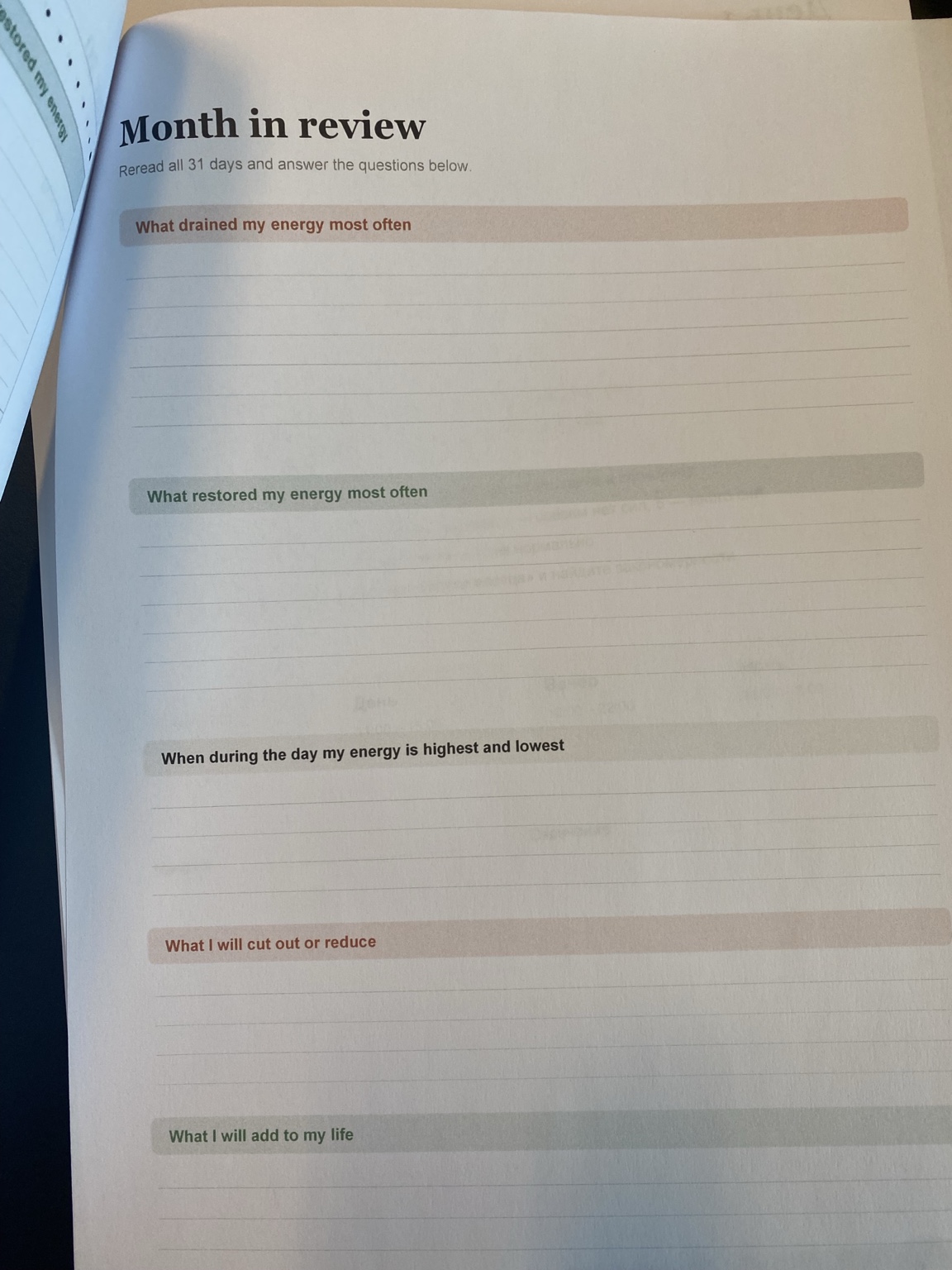
I’m trying to understand why I get tired and what exactly drains my energy. The reasons seem obvious enough: work, immigration, family, living in a foreign country, another language, the constant need to adapt. But I want to understand it more precisely — not just tell myself “I’m tired,” but actually see which things exhaust me and which ones give something back.
I noticed a pattern in myself: when I feel bad, bored, or overwhelmed, I try to get back into a better state through action. Go to a café, go somewhere, find an interesting event, draw, write something for my blog, start a new project. It feels as if movement and interest will bring me back to myself. Sometimes they do. But quite often I end up even more tired.
So instead of guessing, I spent two weeks simply writing down what drained my energy and what restored it.
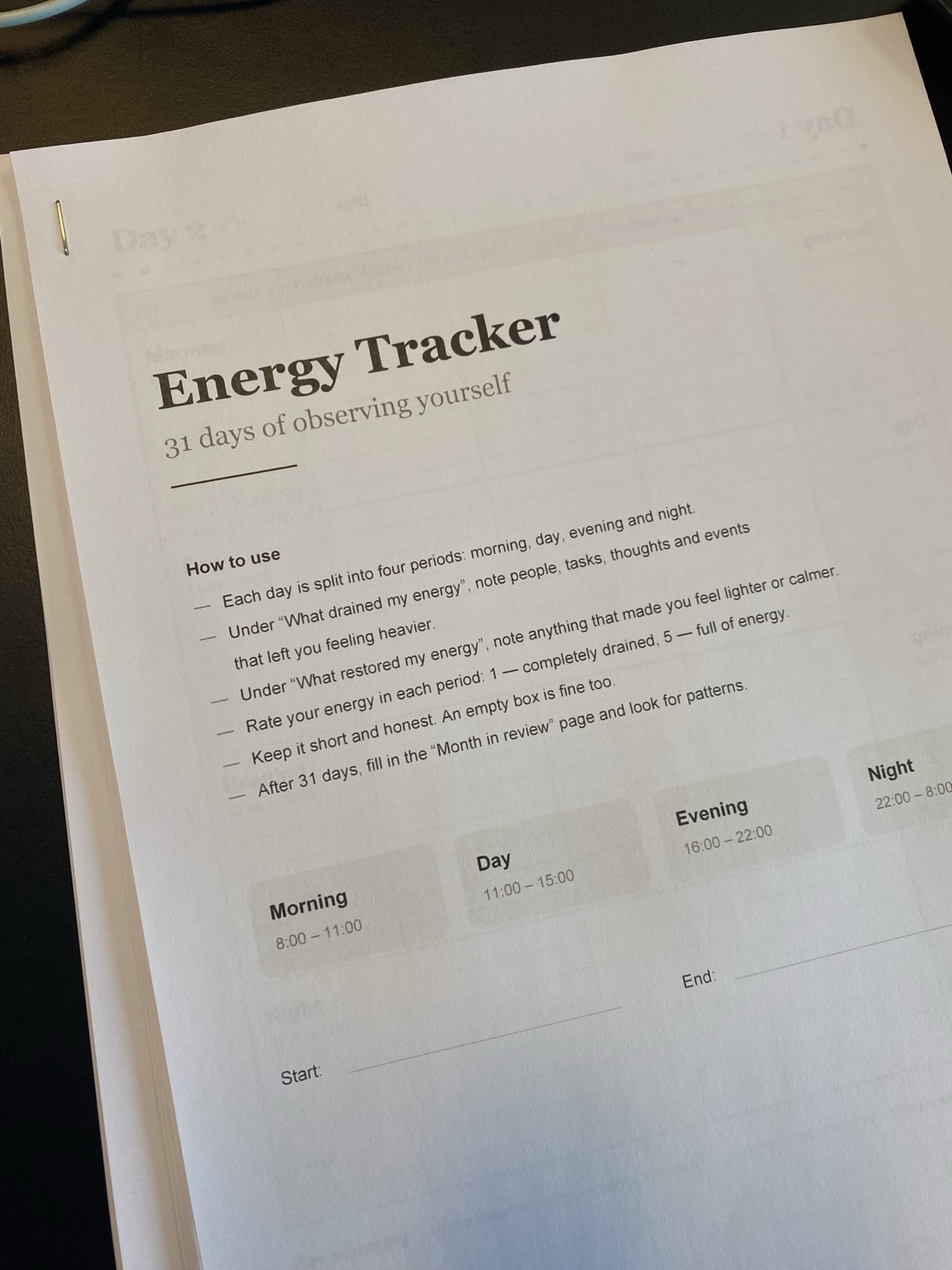
After a while, a few patterns started to emerge.
The first one was very simple: something can be enjoyable without being restorative. I can have a wonderful evening with someone I love and still feel tired afterwards. That doesn’t mean I don’t enjoy being with him or that something is wrong with the relationship. It just means that another person’s presence, even someone very close to me, still requires part of my attention.
The same goes for an interesting event. I can enjoy myself, hear something new, talk to people, and still come home completely drained.
Even drawing, which I love, doesn’t always restore me. I can get absorbed in it for hours and miss the moment when the pleasure has already ended but I keep going because I don’t know how to stop. The same thing happens with my blog. If my main job gives me neither interest nor a sense of accomplishment, I start compensating for it with my own projects and put too much energy into them. At some point, the thing that was supposed to support me turns into a second job.
And the opposite can also be true. A day when almost nothing happens can turn out to be much more restorative. Sleeping well, being alone, going for a walk, quietly doing something of my own — from the outside, it may look like “nothing happened,” but those are often the days after which my energy comes back.
I realised how important autonomy is for me. Not just solitude — I actually know how to be alone, and I like it. What matters is the feeling that my attention belongs to me. That I don’t have to monitor other people’s reactions, adjust to the rhythm of a conversation, figure out what someone wants from me, or get pulled into someone else’s plans or chaos.
That is probably why the office can exhaust me much more than the work itself. You can spend a day without doing an enormous amount of actual work, but still be surrounded by people, inside a system where decisions are made somewhere nearby, processes are vague, plans keep changing, and you are not really included in what is going on. By the evening, you realise you are not tired from design or from Figma. You are tired from the environment.
At the same time, I am definitely not someone who benefits from the advice “just do less.” I need to create. I like making things more convenient, clearer, and more beautiful. I like drawing, inventing things, building systems, improving the space around me. If I go too long without creating anything, I genuinely start to feel stuck.
But that brought me to another important distinction: creating and rescuing are not the same thing.
Making a drawing, writing a text, designing an interface, changing something in my home — that is creating. Trying to organise people who don’t want to be organised, building a process no one intends to follow, endlessly fixing someone else’s chaos, or proving your professional value to people who don’t really want to see it — that is something else.
From the outside, both can look like activity and improvement, but internally they work very differently. I put in a lot of energy, but there is no result that I can truly own or control.
So now I sometimes ask myself: am I actually creating something, or am I trying to rescue a system that never asked me to?
I’ve also started to understand my anger better. When you spend a long time in an environment where you feel invisible or out of place, irritation gradually becomes a background state. Then you start walking around with a tense expression, you feel less like talking, new people keep their distance too, and the circle closes.
I used to think I needed to somehow force myself to be more positive, lighter, more open. Now I see it differently. I don’t need to deliberately become more positive. When I have enough energy, curiosity about people and the desire to talk come back on their own. The problem isn’t that I’m not friendly enough. The problem starts earlier — when I am already exhausted and still expect myself to behave socially as if I weren’t.
I also noticed that I have a habit of trying to fix a bad state immediately. If I’m tired, I want to bring myself back to life through food, cafés, events, shopping, trips, drawing, or a new project. But sometimes the problem is not that I lack stimulation. I simply lack energy.
That distinction has been very useful. Because if what I’m missing is energy, there is no point trying to treat it with yet another activity, even an enjoyable one. Sometimes what helps more is a few hours in which nobody and nothing is asking for my attention.
At the same time, I don’t want to turn recovery into another system of rules and timers. I like going deeply into things. I like intensity. If something interests me, I don’t want to do it for twenty minutes “for balance.” But I clearly need some kind of boundary so that interest doesn’t turn into exhaustion.
It is not necessarily about doing less. It is more about not doing things endlessly.
I think the main conclusion I’ve reached is this: I don’t need a less full life. I don’t need less creativity, less curiosity, or less ambition. I need fewer situations that constantly demand my attention and give almost nothing back.
Fewer attempts to explain myself to people who are not listening. Less fighting with other people’s chaos. Less urge to immediately fix my state through another activity. And more space in which I decide for myself where my energy goes.
I came to this only recently, when I started paying closer attention to myself. It turns out I don’t necessarily recover when I do nothing. I recover when I feel again that my attention, my time, and my energy belong to me.